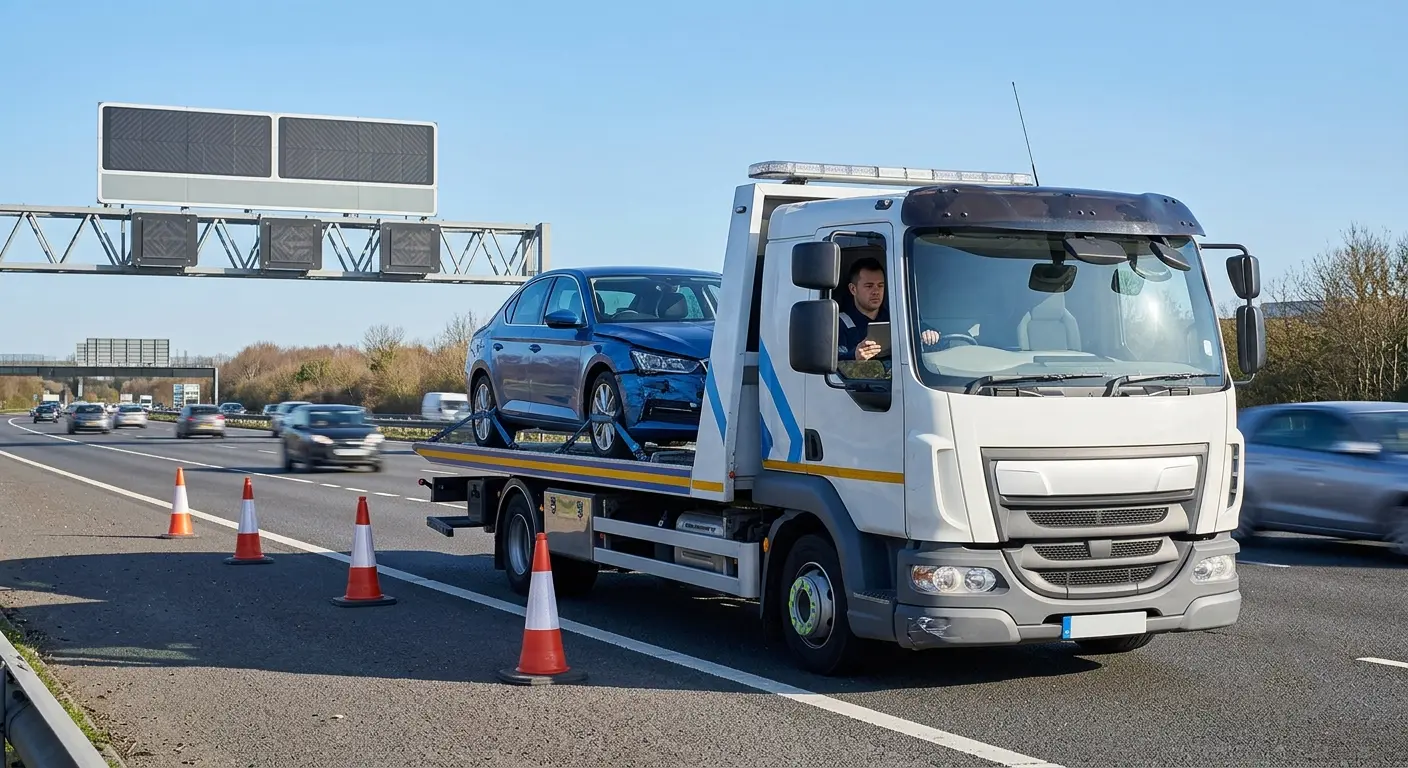
A breakdown never happens at a convenient moment, and at the roadside the first job is getting safe. After that, what you need is someone arriving within a sensible time and taking the vehicle where you choose, not where a policy finds convenient. We run breakdown recovery in Palma de Mallorca around the clock, on flatbeds, with the price fixed before we set off.
A vehicle leaving Palma de Mallorca for the mainland travels under two different transport modes with two different liability regimes. It is worth being clear from the outset about who covers what on each leg, and what documentation travels with the vehicle.
What makes Palma de Mallorca different
It helps to set the context before going into detail. Every vehicle move between Mallorca and the mainland goes by ship, which adds sailing schedules and specific paperwork. Tourist seasonality drives summer demand sharply upward and ferry space gets tight.
The Tramuntana range has narrow mountain roads that require a suitably sized recovery vehicle. There is more background on the city in its Wikipedia entry.
What the law says about moving a vehicle that cannot be driven
Driving without a current ITV carries a fine and can result in the vehicle being immobilised under the rules the Dirección General de Tráfico (DGT) enforces. There is a larger problem behind it: in the event of an accident, your insurer may reduce or refuse cover entirely.
Royal Decree 920/2017 governing the ITV roadworthiness test allows a limited exception for travelling to a booked inspection, but it does not permit normal use of the vehicle. Any other journey requires it to be carried on a transporter.
How a broken-down car should travel
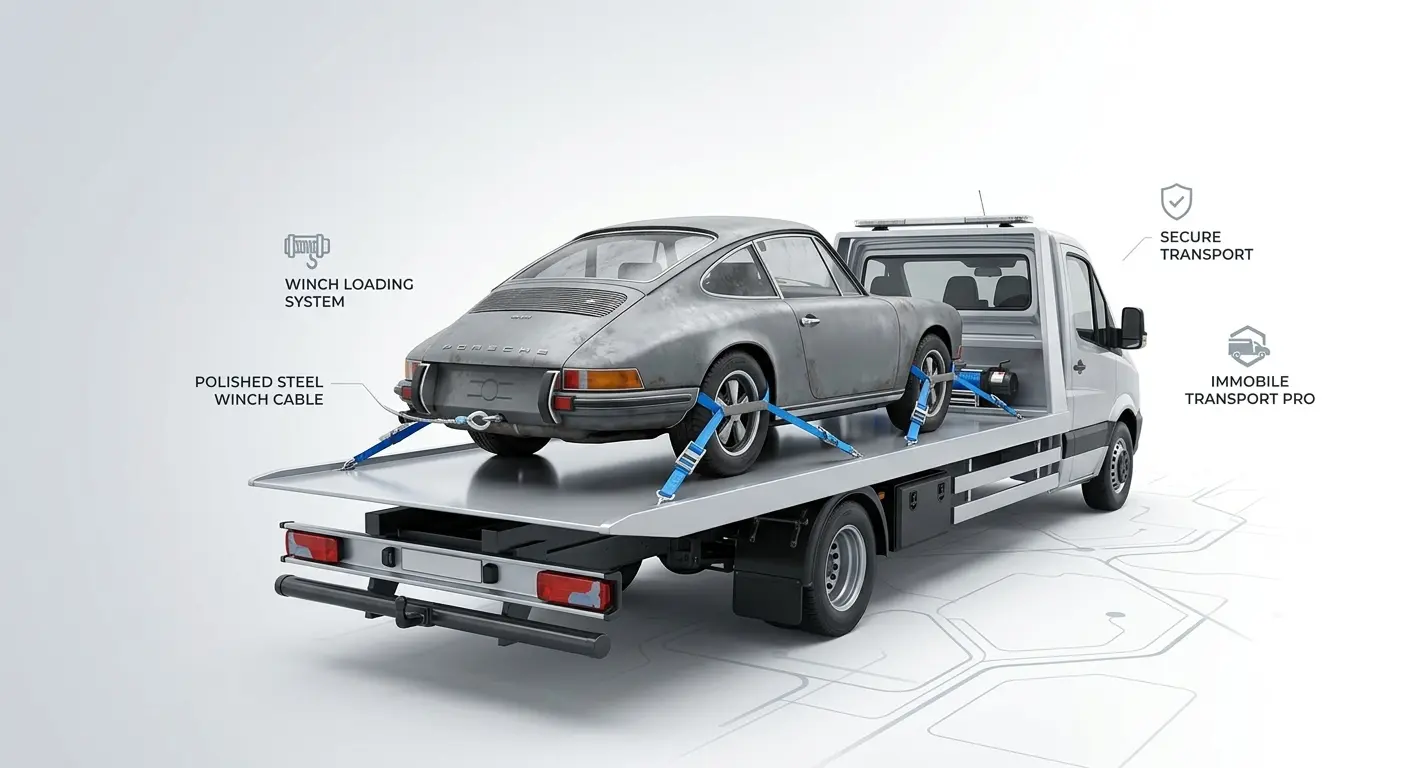
A flatbed carries the whole vehicle on the deck with all four wheels off the ground. That removes tyre wear, spares the transmission a rotation it was never designed for while stationary, and avoids damage to whichever axle would otherwise be rolling.
On vehicles with automatic gearboxes, four-wheel drive or electronic traction systems, a flatbed is not a preference but a manufacturer requirement. Towing with driven wheels in contact with the road can cause serious drivetrain damage.
Breakdowns outside office hours
At three in the morning on a secondary road, waiting feels very long and the situation is objectively less safe. Continuous availability is one of the criteria that matters most when choosing a recovery service.
Being able to resolve the destination out of hours counts too. If the garage is closed, somewhere safe has to be agreed for the vehicle until it opens, and that is part of the job.
Cover and liability during transport
Cover is the detail most often skipped when booking a move. It is not enough for a company to say it is insured — the scope matters, and it should appear on the job documentation alongside the vehicle's condition at the point of loading.
Road haulage is a regulated activity requiring authorisation, overseen by the Spanish Ministry of Transport. An informal operator without authorisation or a transit policy simply shifts the whole risk onto the owner.
Sailing availability from Palma de Mallorca varies considerably through the year, and in summer it can determine the delivery date more than any other factor.
Signs to switch off and leave it
The urge to make it to the garage under your own power is understandable but usually expensive. With oil pressure compromised, an engine can destroy itself within minutes of running, and no warranty covers that.
The same applies to transmissions. An automatic gearbox that has lost fluid or is making unusual noises should not turn a wheel. On four-wheel-drive vehicles, towing with wheels on the road can damage the drivetrain outright, making flatbed transport the only safe option.
Broken down on the road: first steps
People come before the car. If the vehicle still moves, get it onto the hard shoulder or into a service area; if it does not, stop as far right as you can. Then warning devices, high-visibility vest on before you open the door, and everyone out on the side away from traffic.
Since 2026 the connected V-16 beacon has replaced warning triangles on Spanish roads, and its main advantage is that you no longer have to walk along the carriageway to position it. Once the vehicle is marked, wait outside it and behind the barrier — never sitting inside a car on the hard shoulder.
Common breakdowns that end in recovery
By frequency, batteries strand more cars than anything else, followed by starting faults, engine overheating, punctures with no usable spare, and clutch or transmission failures. Modern electronics add a growing category of sensor faults that drop the car into limp mode.
Some of these can be fixed on the spot and some cannot. A flat battery can be jump-started; an engine that has lost coolant and overheated must not be restarted under any circumstances, because every further minute of running deepens damage that may already be irreversible.
A recovery quote, broken down
Price depends on the distance between collection and destination, the vehicle type, how difficult the access is, and the time of day. A night or public holiday call-out costs more, for obvious reasons of availability.
What should not happen is unannounced extras appearing at the end. Charges for awkward access, for a non-rolling vehicle, or for out-of-hours work belong in the original quote.
Other services in Palma de Mallorca
Breakdown recovery in other cities
You can read more about breakdown recovery or browse all our services. For a specific quote in Palma de Mallorca, the quickest route is to get in touch.
Things to check before booking
On long moves, asking how many loading and unloading points the truck has helps explain the timescale. A truck making several stops takes longer than a direct run.
Make sure the alarm is disabled, or that the driver knows how to disable it. An alarm going off in transit means stopping and complicates the job for no reason.
On keyless-start vehicles, remember the fob must travel with you or be handed over at the destination, but never left inside the car in transit. It is a more common oversight than you would think and leaves the vehicle locked on arrival.
If you will not be present at collection or delivery, put in writing who hands over and who receives the keys, with a phone number. This is the single most common cause of avoidable delay.
Always ask whether the price covers collection and delivery at the points you need, or refers to a terminal-to-terminal move. The difference in cost and convenience is considerable.
If the vehicle will sit on a public street waiting for collection, check there are no timed restrictions or scheduled clearing on that road. A car towed by the local authority while waiting for transport complicates matters considerably and adds costs nobody planned for.
If the vehicle has been in an accident, say what is damaged and whether the wheels still turn. A vehicle that will not roll needs a winch and sometimes dollies.
If the destination is an ITV test station, confirm you have a booked appointment and the time. Matching the vehicle's arrival to the appointment slot avoids long waits and a second visit.
A vehicle leaking oil or fuel should be flagged before transport. It does not prevent the move, but it affects where the car sits on the deck and what protection goes underneath it.
If the vehicle is in an underground car park, check the clearance height first. Many garages cannot take a transporter and the car has to be brought up to street level.
Have the vehicle and ownership documents ready. On moves ending at a port terminal or crossing a border, that paperwork matters as much as the vehicle itself.
For vehicles with bulky modifications or accessories — roof racks, bike carriers, bull bars — mention them. They can affect the overall height of the loaded truck and whether it clears certain access points.
If you need the vehicle by a fixed, immovable date, say so when booking rather than afterwards. With enough notice it can almost always be accommodated; with twenty-four hours, often not.
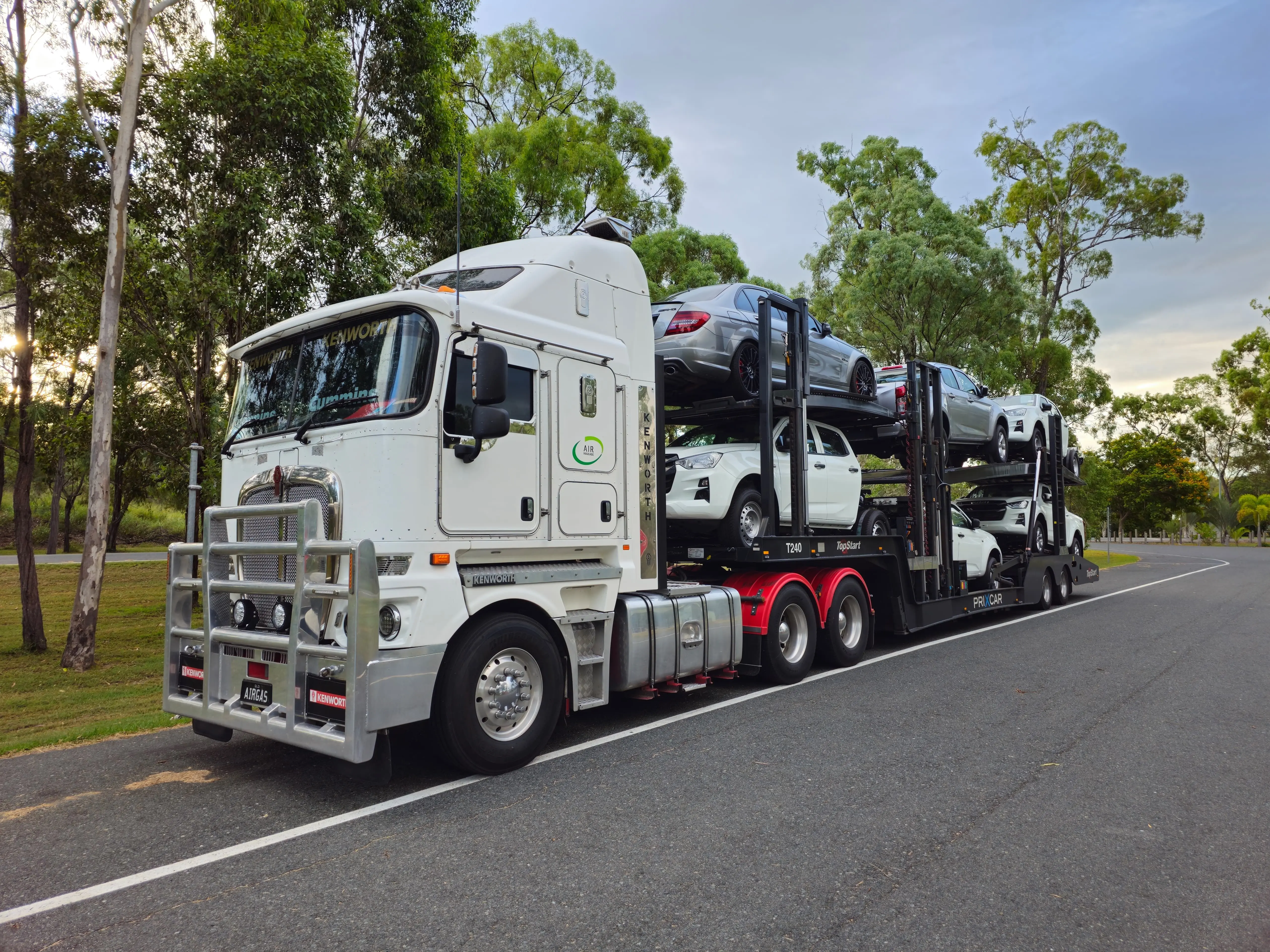
Open transporters are the standard option and perfectly safe for most vehicles. Enclosed transport makes sense for classics, high-value cars and anything with very low ground clearance.
Battery condition matters even for a transport job. If the vehicle has to move a few metres under its own power to get out of a garage or a parking bay, a live battery saves time and avoids resorting to auxiliary equipment.
On vehicles with large-diameter wheels and low-profile tyres, the approach to the ramps needs more care. It is worth mentioning so the right angle is prepared and the tyre or rim is not scuffed.
If the vehicle is on rural land or at the end of an unsurfaced track, state the distance from the tarmac road. An articulated truck cannot enter every lane, and sometimes the car has to be brought out to a meeting point.
Keep the job reference or delivery note. If you later need to evidence the move to an insurer, a workshop or the authorities, that document proves when and how the vehicle was moved.
An accessible collection point saves both time and money. If the street is narrow or the garage has restricted headroom, agreeing a nearby spot where the truck can manoeuvre simplifies everything.
On classic vehicles with carburettors or older systems, say whether the engine needs any particular starting procedure. If it has to be moved even a few metres, that information saves time.
Where a tailgate or bonnet no longer closes properly after an impact, secure it before loading. A tailgate that springs open at eighty kilometres an hour is a genuine hazard to other traffic.
If the collection is from a building with a communal garage, tell the manager or concierge. A transporter manoeuvring on a shared ramp without warning creates avoidable friction with neighbours.
Agree who signs for the vehicle at the destination. If it arrives at a closed workshop or an address where nobody is present, the driver cannot simply leave it, and waiting time or a second attempt both cost money.
In summary
If you need a vehicle moved in Palma de Mallorca, the most useful thing is an assessment of your specific situation. We give you a total price and a realistic timescale, not a per-kilometre rate that grows later.
Need recovery in Palma de Mallorca?
We operate 24 hours a day. Tell us where you are and what has happened, and we will give you a price and a time.